.png)
Trump Faces Backlash From Religious Leaders and Conservatives Over AI Jesus Post and Iran War Threats
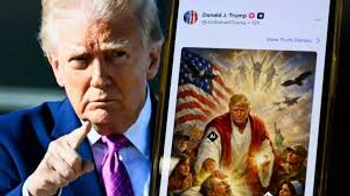
A single social media post depicting Donald Trump as Jesus Christ ignited a firestorm of criticism from some of his most loyal supporters — and it was just one of several controversies that defined a turbulent week for the president. From escalating military threats against Iran to a public clash with the first American-born pope in history, the events raised serious questions about where the boundaries of acceptable presidential conduct lie.
Trump shared an AI-generated image showing himself dressed in robes, with glowing hands and a dark figure lurking in the background — imagery clearly modeled after depictions of Jesus Christ. The post was deleted roughly twelve hours later, an unusual step for a president who rarely reverses course on his social media activity. But the deletion came only after a wave of condemnation that originated not from political opponents on the left, but from Catholic leaders and conservative commentators who said the image was deeply offensive to people of faith.
Isabel Brown, a Catholic podcaster with the Daily Wire and a self-described Trump supporter, did not hold back in her response. She called the post "frankly, disgusting and unacceptable, and also a profound misreading of the American people experiencing a true and beautiful revival of faith in Christ."
Conservative commentator Riley Gaines, who has appeared at Trump campaign events, was equally direct. "I cannot understand why he'd post this. A little humility would serve him well. God shall not be mocked."
Megan Basham, a conservative Protestant Christian writer, called on Trump to take immediate action. "He needs to take this down immediately and ask for forgiveness from the American people and then from God."
When Trump suggested the image depicted a doctor rather than a religious figure, Rev. James Martin, editor-at-large of the Catholic magazine America, pushed back. Speaking to CNN, Martin described the image as "the most Jesus-looking picture I think I could imagine."
A Clash With the Pope
The AI image controversy did not emerge in a vacuum. It followed a very public dispute between Trump and Pope Leo XIV — the first pope ever born in the United States. Trump had labeled the pontiff "weak on crime" and "terrible on foreign policy" after the Pope called for peace during Holy Week and challenged Trump's threats toward Iran. Pope Leo XIV responded plainly: "I have no fear of the Trump administration."
Escalating Iran Threats Raise Alarm
Trump's rhetoric surrounding Iran added a separate layer of concern during the same week. The president issued public warnings suggesting an entire civilization could be wiped out — language that alarmed members of his own party and prompted bipartisan unease in Congress. He later extended a military deadline by two weeks and threatened to fire on any vessel that challenged a U.S. naval blockade of the Strait of Hormuz. Critics from both political parties described the approach as military posturing without a clear strategy, with shifting timelines and repeated delays casting doubt on the administration's credibility.
These incidents were not isolated. Earlier this year, Trump shared a video that ended with an image depicting former President Barack Obama and Michelle Obama as apes. Trump said he had not noticed that portion of the video and did not apologize. After filmmaker Rob Reiner and his wife were murdered, Trump posted a message mocking Reiner rather than expressing condolences.
The accumulation of these events has drawn unusually candid criticism from people who have historically been in Trump's corner. Retired military officials, former diplomats, and onetime media supporters have publicly questioned his conduct and judgment. Former White House lawyer Ty Cobb, who served during Trump's first term, has gone so far as to describe him as "clearly insane."
A Reuters/Ipsos poll from February found that 61 percent of Americans believe Trump has become more erratic as he has aged. This week, Democratic members of Congress introduced legislation that would create a formal commission to evaluate the president's mental fitness. The bill is widely expected to be blocked by the Republican majority, but its introduction drew substantial public attention given how broadly the underlying concerns appear to be shared.
Trump has long positioned himself as a defender of Christian values and a champion of religious Americans. The events of this past week have prompted many observers — including some who support him — to ask how that identity squares with sharing an AI image of himself as Christ and issuing threats about the destruction of entire civilizations.